
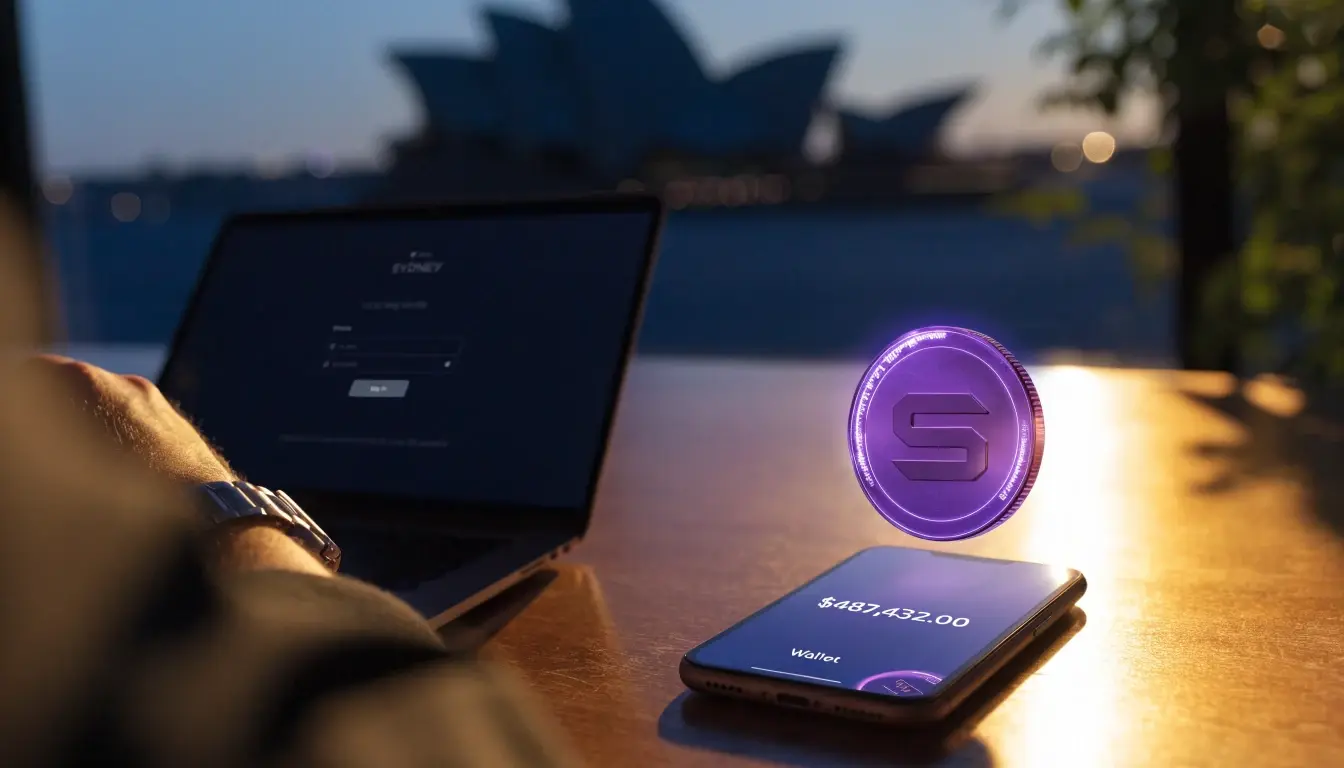
Follow the exchange-to-wallet funding path and assess legal, bonus, transaction and withdrawal trade-offs without treating a shortlist as a verdict.
How SOL Moves Between an Australian Exchange and an Offshore Casino
For an Australian resident, the funding route described for an offshore casino is generally indirect: Australian dollars are deposited with a local crypto exchange, converted to SOL, and sent from an exchange account or personal wallet to a casino wallet. Most Solana casinos do not take AUD directly by bank transfer or credit card. The exchange is therefore the point at which ordinary bank-payment methods meet the on-chain transfer process; it is not a direct AUD payment channel to the casino.
Swyftx, CoinSpot and Coinbase AU support AUD deposits by PayID or bank transfer. After funds arrive, SOL can be purchased through the exchange’s conversion process. The amount received depends on the exchange’s displayed price and any charges it applies. Those commercial details can change, so the figure shown at the time of purchase is more relevant than a general estimate. The choice of exchange also matters because the on-ramp and off-ramp services that convert between SOL and AUD are subject to KYC/AML requirements. Account checks may therefore be required before funds can be deposited, traded or converted back.
Choosing a Solana casino in Australia means checking the details that matter to your own play, including available payment information and licensing. This list offers a concise reference to the facts provided for each operator.
1. Golden Pokies
License: Curacao Golden Pokies is listed with a Curacao license.
2. SkyCrown
License: Tobique Gaming Commission · Payout speed: crypto ~10-15 minutes, fiat 1-5 days · Min. deposit: A$30 SkyCrown is licensed by the Tobique Gaming Commission. Its listed payout speeds are around 10–15 minutes for crypto and 1–5 days for fiat, with a minimum deposit of A$30.
3. Bizzo Casino
License: Curacao Gaming Control Board (TechSolutions Group N.V.) Bizzo Casino is listed under the Curacao Gaming Control Board, with TechSolutions Group N.V. identified.
4. 7Bit Casino
License: Curacao, operated by Dama N.V. 7Bit Casino is listed as Curacao-licensed and operated by Dama N.V.
5. Lucky Dreams
License: Curacao · Min. deposit: A$20 (POLi) Lucky Dreams is listed with a Curacao license. Its stated minimum deposit is A$20 via POLi.
6. GoldenCrown
License: Curacao Gaming Control Board OGL/2023/176/0095 (Hollycorn N.V.) GoldenCrown is listed under Curacao Gaming Control Board license OGL/2023/176/0095, with Hollycorn N.V. identified.
7. SpinsUp
License: Curacao Gaming Control Board OGL/2023/174/0082 (Dama N.V.) SpinsUp is listed under Curacao Gaming Control Board license OGL/2023/174/0082, with Dama N.V. identified.
8. MrPacho
Payout speed: crypto 30-120 minutes, fiat 24-72 hours · Min. deposit: A$30 MrPacho lists crypto payouts of 30–120 minutes and fiat payouts of 24–72 hours. Its stated minimum deposit is A$30.
9. JustCasino
License: Curacao Gaming Control Board JustCasino is listed with a Curacao Gaming Control Board license.
10. Wild Tokyo
License: Curacao · Payout speed: crypto 30-60 minutes, fiat 1-5 days · Min. deposit: A$10 Wild Tokyo is listed with a Curacao license. Its stated payout speeds are 30–60 minutes for crypto and 1–5 days for fiat, and its minimum deposit is A$10.
The next step is a crypto transfer, not another bank payment. A casino deposit page may display a wallet address or a deposit instruction; the exchange or wallet then sends SOL to that destination. The address and asset must match the deposit instructions. Blockchain transfers are irreversible: if SOL is sent to the wrong address, it cannot ordinarily be recalled through a bank or reversed by the exchange. A copied address should therefore be checked before a transfer is authorised, and the transfer should not be treated as equivalent to a reversible card payment.
A deposit may also be subject to a minimum set by the platform. A specialist review has reported minimum SOL deposits in the range of 0.01 to 0.1 SOL, with an AUD equivalent of approximately $2.80 to $28 at April 2026 prices. This is a reported range, not a guaranteed or enduring market standard: the minimum displayed by a particular platform may differ, and the AUD value changes with SOL’s price. The relevant deposit instruction and minimum should be checked at the time of transfer rather than inferred from a general figure.
The wallet arrangement affects how the transfer is made. SOL held on an exchange can be sent from there, while a separate wallet places the user in control of the outgoing transaction. In either case, the casino’s deposit address must be used exactly as presented. A platform may credit a deposit only after it recognises the incoming transaction; a transfer appearing in a wallet does not by itself establish that the casino has credited an account. This distinction makes the platform’s deposit instructions important, particularly where an account uses a specific address or requires an additional reference.
Casino Sites Accepting Credit Cards in Australia
Converting back follows the route in reverse: SOL is withdrawn from the casino to an exchange or wallet, then sold for AUD and withdrawn through the exchange’s available banking methods. The conversion service’s KYC/AML requirements apply on this side too. Larger withdrawals or bonus-related cash-outs may also prompt KYC checks at the casino, including a request for identity documents. A withdrawal route can therefore involve both the platform’s own account checks and the exchange’s requirements, rather than a single transfer from casino balance to bank account.
The amount ultimately received in AUD is not fixed at the moment of deposit. SOL’s price can move while funds are held or while a withdrawal is being processed, reducing the AUD value of winnings between deposit and conversion. This is distinct from the mechanics of sending the tokens: a successful transfer does not preserve a particular AUD value. Cash-out terms should be read before depositing, including any conditions that could affect whether funds can be withdrawn. The existence of a wallet address or a completed blockchain transfer does not settle those conditions.
These payment mechanics do not make an offshore casino a permitted Australian service. The Interactive Gambling Act 2001 prohibits offshore operators from providing online casino games to Australian residents. The transfer route is a description of how crypto may move, not an indication that using the service is legally safe. A VPN does not remove the risk of an operator restricting or seizing an account, with potential loss of funds, and Australian authorities do not provide recourse if an offshore platform withholds a balance.
Legal Risk
Offshore casinos are prohibited by the Interactive Gambling Act 2001. Australian authorities provide no recourse if an offshore platform withholds funds or seizes an account.
Assessing a Solana Casino Without Treating a Shortlist as a Verdict
A shortlist can identify platforms worth examining, but it cannot establish that any one is suitable or reliable. A comparison is only as strong as the evidence behind it: promotional claims, interface design and a large game catalogue do not answer whether the terms are clear, the games can be assessed, or withdrawals are subject to conditions that were visible before a deposit.
For Australian residents, this distinction has a further legal context. The Interactive Gambling Act 2001 prohibits offshore operators from providing online casino games to people in Australia. A comparison of offshore services should not be read as an endorsement or as a finding that any service is lawful to use. Nor does a favourable review make an offshore casino legally safe.
Check what a licence claim actually establishes
A platform’s own statement that it is licensed is not, by itself, enough to establish the scope or current status of that licence. A careful comparison records the named licensing authority, the entity that holds the licence and the services the licence covers, then checks whether those details can be corroborated through the regulator’s own information. A badge or logo without a verifiable explanation provides little evidence.
Licensing also should not be treated as a single measure of consumer protection. A licence from an overseas authority does not remove the Australian restrictions on offshore casino services, and it does not establish that Australian authorities can resolve a dispute with the operator. Under the Australian framework, these services are prohibited for operators, while individual players are not directly penalised for using them. The distinction matters: the absence of a player penalty is not equivalent to legal approval or a reliable route for recovering funds.
Same-Day Casino Payouts in Australia: How Timing Works · Casino Sites That Accept BPAY in Australia: Evidence
ACMA’s public Gambling Prohibition Register is relevant to the Australian context because it identifies unlicensed gambling sites subject to the regulator’s action. Its inclusion or absence should not be mistaken for a complete quality assessment of a platform. A comparison should state what a register check does and does not show, rather than using it as a substitute for examining the operator’s claims.
Treat RTP and fairness as separate evidence questions
RTP is a theoretical measure associated with a game over extended play, not a forecast of an individual session’s result. A platform-wide RTP claim is difficult to evaluate unless it identifies the games or game versions covered and makes the relevant figures accessible. If a casino does not provide this information in a form that can be checked, the appropriate comparison entry is that the claim could not be substantiated—not an inferred rating.
Fairness tools require similar scrutiny. “Provably fair” is not a complete explanation of how a game works. The platform should explain what information is used, how a result can be checked and what part of the game the verification covers. The presence of a verification feature does not, on its own, establish that every game on the site uses it or that other aspects of the service have been independently assessed. Where the method is unclear, the uncertainty should remain visible in the comparison.
Do
- Corroborate licensing details through the regulator’s own information
- Check if the fairness verification covers every game on the site
- Verify the specific games covered by a platform-wide RTP claim
Don’t
- Treat a license badge or logo as verifiable evidence
- Assume a “provably fair” label explains the entire game mechanism
- Use an inferred rating when RTP claims cannot be substantiated
Read bonus terms as a calculation, not a headline
A prominent bonus figure says little about its practical value without the associated conditions. A specialist review’s method for estimating effective bonus value considers playthrough, game contribution percentages, time limits and maximum cash-out caps. Those elements affect how much qualifying play is required, which games count towards it, how long the conditions remain available and whether a limit applies to resulting withdrawals.
The relevant terms should be examined before a deposit, including whether bonus funds and winnings are treated differently and whether accepting an offer changes withdrawal eligibility. A comparison that reports only the advertised bonus amount omits the conditions that determine whether it can be used or withdrawn. If the terms are incomplete, contradictory or difficult to locate, that is material evidence about the offer’s transparency.
This assessment is distinct from calculating any particular promotion’s wagering requirement. The central comparison question is whether the rules are stated clearly enough to evaluate at all. Promotional language should not be converted into a claim of value without accounting for its restrictions.
Check the cash-out rules before assigning a rating
Withdrawal terms should be read before funds are deposited, not after a balance has accumulated. The published policy should explain whether KYC checks can be required, what identity documents may be requested and whether a withdrawal can be held while checks are completed. Larger withdrawals or bonus cash-outs may trigger KYC checks requiring ID verification; a comparison that omits this possibility leaves an important condition undisclosed.
EcoPayz casino sites in Australia: what is verified · Casinos That Accept CashtoCode in Australia
SOL transfers are irreversible, so an address error can result in permanent loss. SOL price volatility can also reduce the value of winnings between deposit and withdrawal. These are separate risks from an operator’s processing policy and should not be obscured by a claim about fast network transactions. Offshore operators also offer limited consumer protection, with no recourse through Australian authorities if funds are withheld or a platform closes. VPN use may lead to account seizure and loss of funds, rather than providing a dependable safeguard.
A useful comparison therefore records the evidence and its limits, rather than producing a verdict from a shortlist. Licensing, RTP, fairness methods, bonus conditions and KYC rules each require separate checks. If a platform does not disclose enough to verify a claim, the gap should remain explicit; it should not be filled by a rating, a promotional label or an assumption that the service is suitable for Australian residents.
Australia’s Legal Position on Offshore Solana Casinos
The Interactive Gambling Act 2001 places the principal legal prohibition on operators, not on individual Australian players. Overseas operators are prohibited from offering online casino services to people in Australia. The restriction covers real-money casino gambling; using SOL rather than Australian dollars does not, by itself, change the nature of the service.
Legal Distinction
The Interactive Gambling Act 2001 prohibits offshore operators from providing services, but it does not directly penalise individual Australian players for using them.
For an Australian resident, the distinction is important but should not be mistaken for approval or legal safety. The Act does not directly penalise an individual punter merely for using an offshore casino. That does not make the operator’s service lawful in Australia, nor does it mean that a player has a protected right to use the platform. The absence of direct player penalties is not evidence that an offshore Solana casino is authorised to serve Australian residents.
Enforcement is directed at the provision of prohibited services. The Australian Communications and Media Authority (ACMA) enforces the Act and can block access to unlicensed offshore gambling websites. A block can make a site inaccessible from Australia, but it does not establish that the operator has been brought under Australian oversight or that a player’s funds are protected. Nor should access at a particular time be treated as proof that a service is permitted.
The position is not altered by describing a platform as crypto-based. Solana is a payment network and SOL is a digital asset; neither supplies an Australian gambling licence. A specialist review reports that, as of mid-2026, no specific Australian licensing framework for crypto-gambling operators had materialised. That observation concerns the absence of a dedicated framework; it should not be read as a route around the existing prohibition on overseas operators providing online casino services to Australian residents.
Anonymous Crypto Casinos in Australia: Rules and Risks
The practical consequence is a marked gap between operator restrictions and player remedies. If an offshore platform freezes an account or withholds winnings, Australian law does not provide the player with legal protection against that casino. The operator may be based outside Australia, and the availability of a website or the use of a familiar cryptocurrency does not create an Australian avenue for compelling payment. A dispute may therefore leave the player without effective recourse through Australian authorities.
This risk is distinct from direct liability under the Act. A person may not be directly penalised for playing, while still facing the possibility of losing access to funds with no Australian legal remedy. It is therefore inaccurate to infer that offshore gambling is legally safe because individual players are not the Act’s target, or because no enforcement action against a particular player is known. The legal treatment of the operator and the practical position of the player are separate questions.
Using a VPN does not resolve either issue. It does not change the underlying prohibition on an overseas operator serving Australian residents, and a casino may respond to suspected circumvention by restricting an account or retaining funds. Offshore operators also sit outside the protections available through Australian gambling regulation. Their terms and internal decisions may be difficult to challenge locally, particularly if the platform closes or refuses to return a balance.
Accordingly, “Solana casino Australia” describes a search for offshore access, not a category of locally authorised casino. The relevant legal boundary is the service being offered to people in Australia, rather than whether deposits and play are denominated in SOL. The absence of direct player penalties should be stated alongside—not instead of—the operator prohibition, ACMA’s blocking role, and the lack of Australian recourse when an offshore casino withholds funds.
Legal Position
- Overseas operators are prohibited from offering casino services to Australians
- ACMA may block access to unlicensed offshore gambling websites
- Individual players are not directly penalised under the Act
- No Australian legal remedy exists if an offshore operator withholds funds
- VPN use does not change the underlying prohibition or guarantee fund safety
Slot Bonuses: Wagering, Free Spins and Cash-Out Conditions
A slot promotion can add a wagering obligation rather than immediately increase the amount available to withdraw. Where winnings come from bonus funds, those winnings must be wagered with real money before withdrawal. The displayed balance therefore does not, by itself, show how much can be cashed out: the bonus terms determine which funds are restricted and what playthrough remains.
The calculation depends on the stated basis. A multiplier applied to the bonus alone is different from one applied to the combined deposit and bonus. A specialist review describes a 35x requirement calculated on the bonus only; that wording matters because it identifies the amount to which the multiplier applies. If the terms instead use a combined balance, the required turnover would be calculated from a different base. The precise rule must be established from the promotion’s own terms, not inferred from the headline offer.
The arithmetic is direct once the base is clear. A 40x requirement on a 5 SOL bonus calls for 200 SOL in bets before withdrawal eligibility. That figure is turnover, not a payment to the casino and not a guaranteed loss of that amount. It is the total value of qualifying bets required under the stated rule; the balance may change as play proceeds. Whether a particular bet qualifies is a separate question governed by the promotion conditions.
Free spins can create a second set of terms. A specialist review describes cases in which winnings from free spins are credited as bonus funds and then carry a separate wagering requirement, with 50x given as an example. In that arrangement, completing a wagering condition attached to the original bonus would not necessarily clear the free-spin winnings as well. The crediting method and the applicable multiplier need to be read together.
Online casino payment methods in Australia
For slot promotions associated with Solana casinos, the key distinction is between a promotional balance and withdrawable funds. A free-spin result may appear in the account without being immediately cashable, while bonus-derived winnings may remain subject to real-money wagering. The label attached to a balance is not enough to establish its status; the promotion’s rules specify how it becomes eligible for withdrawal.
The terms should be checked before depositing or activating an offer, particularly where the promotion presents free spins alongside a bonus. Relevant details include the wagering base, whether free-spin winnings have their own requirement, and what counts as qualifying play. A headline multiplier without its base can obscure the actual turnover obligation. Terms can also define conditions that affect whether a completed playthrough results in a payable balance, so eligibility should not be assumed from the multiplier alone.
These mechanics do not alter the Australian legal position: the Interactive Gambling Act 2001 prohibits offshore operators from providing online casino games to Australian residents. A promotional balance is not evidence of legal protection or a guaranteed cash-out. The distinction between bonus funds and withdrawable funds is therefore practical as well as mathematical: the former may carry conditions that remain unresolved even when a balance is visible.
NFT Claims and the Limits of What Can Be Verified
Interest in a casino using Solana can extend beyond its payment network to claims about non-fungible tokens (NFTs). The term may refer to several different ideas: a casino accepting an NFT as an entry credential, issuing NFTs as rewards, linking a token to an account, or allowing an NFT to affect gameplay. These are distinct functions. The presence of Solana support alone does not establish any of them.
Attention: Support for USDC on Solana is evidence of payment compatibility, not proof of NFT functionality or ownership features.
A specialist review reports that some Solana casino platforms accept USDC on Solana as well as SOL. That is evidence about payment support, not NFT functionality. USDC is a fungible token; an NFT is a distinct token with its own on-chain identity. A platform that handles one type of asset cannot therefore be assumed to handle the other, or to use NFTs in any particular way.
An NFT-related claim needs to identify what the token does and how the function operates. A reference to “NFT rewards”, for instance, does not by itself show whether a token is actually issued, what rights or benefits it conveys, or whether it can be transferred independently of an account. Likewise, an image or collection displayed on a website does not demonstrate that the casino recognises ownership on-chain. Without evidence tying a specific token to a defined function, the claim remains unclear.
The distinction matters because blockchain visibility and casino account records are not interchangeable. A token may exist on a public network while access to a platform feature depends on the operator’s own systems and terms. Conversely, a promotional label may describe an off-chain benefit rather than an NFT. The wording of a claim is not enough to establish how it is implemented.
For a comparison, NFT claims should therefore be treated as separate from ordinary SOL deposits or USDC support. The relevant evidence would need to describe the token, its function, and the conditions governing its use or ownership. In the absence of that detail, it is not possible to conclude that a platform offers a casino NFT feature merely because it operates on Solana or accepts a Solana-based asset.
PayID Pokies in Australia: Payments and Limits · Paysafecard Casino Sites in Australia: Verified Claims
This restraint also avoids treating a broad category as a confirmed product feature. “NFT casino” can describe a proposed concept, a marketing phrase, or a specific technical arrangement; those meanings should not be collapsed. The available reporting establishes some USDC support on Solana, but does not establish particular NFT functionality. Claims beyond that distinction cannot be presented as verified.
Any transfer of SOL remains irreversible: funds sent to the wrong address may be permanently lost. Separately, offshore operators are prohibited under the Interactive Gambling Act 2001 from providing online casino games to Australian residents; using an offshore service is not legally safe merely because individual players are not directly penalised.
Crypto Gambling and Australian Tax Treatment
Tax treatment of gambling proceeds and the cryptocurrency used to place a bet are separate questions. In Australia, winnings from recreational gambling are generally not taxable as income. That general treatment does not, however, mean that a cryptocurrency balance involved in gambling falls outside tax rules.
The Australian Taxation Office regards cryptocurrency as an asset for capital gains tax purposes. Accordingly, gains associated with gambling using SOL may be subject to Capital Gains Tax, even where the activity is recreational and the gambling winnings themselves would generally not be taxed. The distinction is between the character of a gambling win and the tax treatment of the crypto asset: the first does not automatically determine the second.
Tax Treatment Contrast
While recreational gambling winnings are generally not taxable as income in Australia, the cryptocurrency used (such as SOL) is regarded as an asset for capital gains tax purposes. This means gains from the asset itself may be taxable even if the gambling winnings are not.
This matters when interpreting the apparent value of a result from a Solana-based crypto casino. A balance shown in SOL is not necessarily equivalent to a fixed amount of Australian dollars, and the tax treatment of the asset may need to be considered separately from the gambling outcome. The available general rules do not establish a universal calculation for every transaction or personal circumstance, so the treatment of a particular result should not be inferred solely from the fact that it arose through gambling.
Losses are also treated narrowly. A specialist tax review characterises the ability to offset gambling losses against gains as limited to people recognised as professional gamblers, a status that is difficult to establish. Recreational participation alone should therefore not be taken as grounds for deducting losses or using them to reduce other gains. Nor does a losing gambling session necessarily cancel a capital gain connected with SOL.
The practical distinction is consequential: recreational winnings may generally be outside income tax, while gains involving SOL can still raise a capital gains issue. These are not contradictory positions; they concern different aspects of the activity. The professional-gambler exception is not a general loss-relief rule, and the threshold for relying on it is high. Anyone assessing an individual return needs to distinguish gambling proceeds from changes in the value or tax treatment of the crypto asset, rather than treating every win or loss as one undifferentiated gambling result.
Bitcoin Casinos in Australia: Legal and Payment Guide · Casinos That Accept Visa in Australia: What Is Verified
Dice Play and the Cost of Solana Transactions
The network fee is a small part of the cost model for any dice-style play that requires an on-chain action. A specialist review reports an average Solana transaction fee of $0.00025 USD per transaction, a near-zero charge in ordinary terms. That figure describes the network fee, not the total cost of gambling: it does not include any platform charge, the value of a wager, or losses arising from game outcomes.
The distinction between a wager recorded on-chain and one handled within a casino account matters. If each dice action requires a separate Solana transaction, network fees may recur with each action. If play is processed within the platform and only deposits or withdrawals are recorded on-chain, the network fee may apply at those transfer points instead. Without details of a particular game’s transaction design, neither pattern can be assumed for a dice casino operating on Solana.
A low fee can therefore make frequent transactions less costly at the network layer, but it does not establish that a game is fair, that a platform is reliable, or that the overall cost of play is low. The transaction fee is separate from any house advantage and from the amount placed at risk. It should not be treated as a measure of expected loss or as evidence that repeated play is financially insignificant.
The reported average is also not a guaranteed charge for every transaction. Network conditions can change, and a casino’s own terms may impose charges distinct from Solana’s fee. The relevant comparison is consequently between the network cost and all other costs attached to a transaction, rather than the network figure in isolation.
Network Fees
Average Solana transaction fees are approximately $0.00025 USD, though this network cost is separate from platform charges or game wagers.
This distinction does not alter the legal position in Australia: the Interactive Gambling Act 2001 prohibits offshore operators from providing online casino games to Australian residents. A low transaction fee does not make offshore play legally safe or create Australian consumer protections. SOL transfers are irreversible; funds sent to the wrong address may be permanently lost. SOL’s price can also move between deposit and withdrawal, reducing the AUD value of any balance or winnings. These risks remain even when the network fee itself is near zero.
Game Contributions and the Real Cost of Casino Bonuses
A bonus’s stated size does not show how much usable value it provides. Its practical worth depends partly on which games count toward the wagering requirement and how much each category contributes. When a game contributes less than the full stake, more total betting may be needed to register the same progress than when play is fully counted.
Slots are commonly assigned full contribution, while blackjack and roulette may count for only a fraction of the stake. The distinction matters when a promotion appears usable across casino games: eligibility to play a game does not mean that its wagers advance the bonus requirement at the same rate. A bonus balance used on a low-contribution category can therefore remain subject to substantial playthrough even as the player makes repeated bets.
PayID Casino Withdrawals in Australia: Timing and Rules · Skrill Casino Sites in Australia: What Is Verified
This weighting can also alter the apparent value of a promotion across game types. A stated bonus amount is not equivalent to an equal amount of withdrawable funds. The requirement may need to be completed before winnings from bonus funds can be withdrawn, and game contribution rules affect how much qualifying activity is required. Where a bonus is restricted to particular categories, or where some games count only partially, the nominal offer may overstate its practical value.
A useful assessment considers the playthrough obligation alongside each game’s contribution, any time limit, and any cap on cashout. A specialist review describes effective bonus value as requiring these factors to be considered together; the headline amount alone cannot establish the likely cashable return. If a cashout cap is lower than the balance accumulated during play, part of that balance may not be withdrawable under the promotion’s terms. A time limit can likewise make completion harder, particularly where the selected games contribute less.
The arithmetic is straightforward in principle: only the eligible share of each wager advances the requirement. A full-contribution game advances it by the entire qualifying stake; a game with a lower contribution advances it by less. That difference can make the same bonus materially less attractive for someone intending to play table games rather than slots.
Bonus comparisons across solana casino games should therefore distinguish game access from wagering credit. The relevant terms are the contribution assigned to each category, the amount of playthrough, the completion period, and the cashout ceiling. Without those conditions, a nominal bonus cannot be treated as a reliable measure of value.
Evaluate Bonus Value
- Identify the wagering base (bonus only vs. deposit + bonus)
- Check game contribution percentages for intended games
- Verify the completion time limit
- Confirm the maximum cash-out cap
SOL, USDC and the Practical Value of On-Chain Casino Balances
A balance shown in SOL and one shown in USDC on Solana represent different assets, even when both are held or transferred through the same network. SOL is Solana’s native asset; USDC is a separate token that can be transferred on Solana. The network used for a transfer does not make the assets interchangeable, and a platform’s support for one does not establish that it supports the other.
A specialist review reports that some Solana casinos accept USDC on Solana for deposits and play as well as SOL. This is a platform-specific payment option, not evidence that every casino supports both assets. The deposit instructions and account balance display need to identify the accepted asset and network clearly. Sending a token to an address or network that does not support it can make recovery difficult or impossible.
The phrase “casino token” can also refer to several different things: SOL used to fund an account, USDC transferred on Solana, or a token issued by an individual operator. Support for the first two does not establish that an operator has created its own token, or that such a token has a particular function. A listed balance should therefore be understood according to the asset actually named, rather than treated as a special casino currency.
A specialist review reports that Solana transactions can confirm in about 400 milliseconds, with balances updating immediately. That describes the network-level transfer and display experience, not every step in a casino account’s handling of funds. An on-chain confirmation cannot establish how an operator records a deposit internally or whether it will accept a withdrawal request.
SOL balances also expose the account to changes in SOL’s value: winnings held in SOL can be worth less in Australian dollars by the time they are withdrawn. A USDC balance avoids measuring the account in SOL, but it remains a crypto asset held through an offshore service, not an Australian-dollar bank balance. The distinction matters when comparing the amount displayed with the amount ultimately received after conversion.
Payments and Crypto for Australian Casinos
Transfers of SOL are irreversible. An incorrect destination can result in permanent loss, so the asset and destination details should be checked before sending. Cash-out terms should likewise be reviewed before depositing; a visible on-chain balance alone does not establish that funds can be withdrawn on the expected terms.
Withdrawal Processing, Network Speed and Cash-Out Risk
A Solana transaction can confirm quickly without a casino releasing funds quickly. A specialist review reports confirmation in about 400 milliseconds, but this describes network activity, not the operator’s approval or payment queue. Specialist reviews also report native SOL withdrawals processing in 30–60 seconds on competent platforms and describe under 10 minutes as a fast withdrawal benchmark. These are reported timings, not guarantees.
The operator’s own process can take longer. Reported processing ranges from 5–15 minutes where withdrawals are automated to as long as 72 hours where they are handled manually. Network congestion and internal processing both affect the elapsed time. Some specialist reviews also report operator withdrawal charges of 0.1% to 1%; the applicable fee should be established from the platform’s terms rather than assumed.
Instant PayID Withdrawals in Australia: What to Expect
Cash-out can involve checks as well as delay. Larger withdrawals or bonus-related cashouts may trigger KYC checks requiring identity documents. Cash-out conditions should therefore be read before depositing, not after a win. SOL transfers are irreversible: an incorrect address can mean permanent loss, and a transfer sent to the wrong destination cannot be recalled. SOL price volatility can also reduce the AUD value of winnings between deposit and withdrawal.
Offshore operators are prohibited under the Interactive Gambling Act 2001 from providing online casino games to Australian residents. Using one is not legally safe merely because individual players are not directly penalised. Australian authorities do not provide recourse if an offshore operator withholds funds or closes, leaving limited consumer protection. VPN use may also lead to account seizure and loss of funds. These risks sit outside the speed of Solana’s network and cannot be resolved by rapid confirmation.
How do I play at Solana online casinos from Australia?
Buy SOL through an Australian exchange using AUD, then send it to the casino’s deposit address from your exchange account or wallet. Check the address and deposit instructions carefully: blockchain transfers are generally irreversible. Offshore casinos are prohibited from offering online casino services to Australian residents.
Is it legal to use Solana casinos in Australia?
The Interactive Gambling Act 2001 prohibits offshore operators from offering online casino services to Australian residents, although the Act targets operators rather than directly penalising individual players. Australians can legally buy, hold and transfer SOL, but using it at offshore casinos carries legal and financial risks, including no Australian legal protection if funds are withheld.
What is the minimum deposit for a Solana casino?
Reported minimums range from 0.01 to 0.1 SOL, approximately A$2.80 to A$28 at April 2026 prices. Check the casino’s deposit instructions, as minimums and their AUD value can vary.
Can I deposit other cryptocurrencies at a Solana casino?
Yes. Some Solana casinos accept USDC on Solana as well as SOL.
How does Solana compare to other casino deposit methods?
SOL transfers are fast and have an average transaction fee of about US$0.00025, but they are not reversible like a card payment may be. Most Solana casinos do not accept AUD directly, so you generally need to buy SOL through an exchange first.
Can I use Australian dollars directly?
Generally, no: most Solana casinos do not accept AUD deposits by bank transfer or credit card. You can deposit AUD with an Australian exchange, buy SOL and transfer it to the casino.